


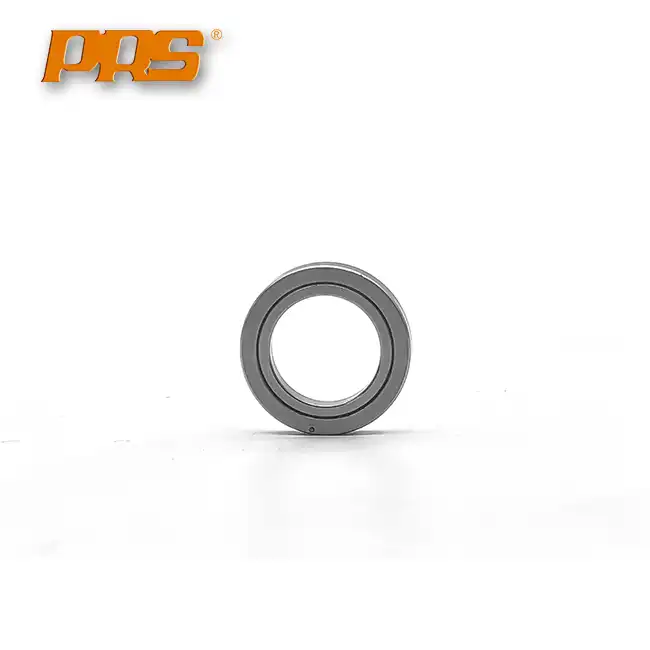
RAU robot arm bearing
Brand: PRS
Category: Bearing
Seal: Double-sided seal
Size: Inner diameter 20mm-50mm, Outer diameter 31mm-61mm
Thickness: 5mm
- Product Description
RAU Robot Arm Bearing – Ultra-Thin Precision Solution for Compact Robotic Joints
RAU robot arm bearing series from Luoyang PRS Precision Bearing Co., Ltd. is designed for extreme downsizing. This ultra-thin crossed roller bearing eliminates mounting holes on both inner and outer rings, saving space across the range at 5mm thickness. Installation of RAU models requires flange-mounted support seats. Inner diameters range from 20mm to 50mm and exterior diameters from 31mm to 61mm. These P4 and P2 precision bearings use crisscross rollers to handle radial, axial, and moment stresses. Since 2003, PRS has provided precision bearings that fulfill ISO-aligned quality requirements for robotics, medical devices, and industrial automation systems.

Engineering Design and Working Principle
The crossed roller layout places cylindrical rollers perpendicularly between raceways. This setup distributes stresses over several contact points, avoiding paired bearing installations.
Each roller hits raceways at optimal angles. Multi-directional loads become homogeneous stress with this shape. The ultra-thin profile minimizes joint envelope size without reducing load.
Dual-sided seals keep interior components clean. Chrome steel is strong and durable for industrial use. Inner/outer ring geometry is simplified without mounting holes, maximizing raceway length in minimum axial space.
Technical Specifications
| Parameter | Specification |
|---|---|
| Model Series | RAU |
| Inner Diameter Range | 20mm – 50mm |
| Outer Diameter Range | 31mm – 61mm |
| Thickness | 5mm |
| Seal Type | Double-sided |
| Precision Grade | P4 / P2 |
| Material | Chrome Steel |
| Mounting Method | Flange + Support Seat |
| Origin | China |
| Brand | PRS |
Application Engineering Benefits
Size-constrained robotic joints benefit from 5mm thickness. Collaborative robot wrists, precise turntables, and small rotary indexers enhance degrees of freedom without expanding.
Modular robotic design well accommodates flange-mounting. Engineers design support seats for certain house shapes. This adaptability fits medical robots and semiconductor handling equipment's compact packaging.
Cantilevered tooling is supported by high moment load. Under multi-axis robotic system loading situations, the RAU robot arm bearing maintains positioning precision. Friction reduction boosts motor efficiency and lifespan.

Quality Control and Manufacturing Process
PRS employs stage-gate quality control from raw material to final assembly. Raceway surfaces are uniformly hardened by heat treatment. P2-grade tolerances are maintained during precision grinding.
Each bearing is rotated under load to ensure smooth performance and no faults. Noise and vibration tests corroborate roller spacing and raceway shape. Advanced metrology checks dimensions before packing.
QMS uses ISO 9001 framework concepts. Each production batch includes traceability documentation for important application lifecycle tracking.
Installation and Maintenance Guidelines
Precision-machined flanges with bearing-grade perpendicularity tolerances are needed for installation. Support seats must clamp circumferences evenly to avoid ring deformation.
Environmental exposure and operational speeds determine lubrication intervals. Factory-applied grease fits most moderate-duty uses. Manufacturer recommendations may mandate frequent relubrication of high-speed or continuous-duty systems.
Thermal expansion is prevented via temperature monitoring. Operating temperatures should respect chrome steel restrictions. Seal inspection must be more frequent in contaminated situations for long-term dependability.

Customization Capabilities
PRS engineers accommodate non-standard dimensions. Custom inner/outer diameters accommodate specific space restrictions. Seal configurations are tailored to environmental protection.
Stainless steel is a corrosion-resistant option. Rapid prototyping speeds up specialized equipment development. Bearing selection calculations and installation detail suggestions are technical help.
Custom orders have short lead times due to excellent production management. OEM partners and high-volume consumers benefit from long-term supply arrangements.
FAQ
Q: What distinguishes RAU models from standard crossed roller bearings?
A: RAU series eliminates mounting holes, achieving ultra-thin 5mm profile for maximum space efficiency in compact assemblies.
Q: Can RAU bearings handle combined radial and axial loads?
A: Yes, the crossed roller arrangement simultaneously supports radial, axial, and moment loads through optimized contact geometry.
Q: What precision grades are available?
A: Standard production includes P4 grade, with P2 precision available for applications requiring tighter tolerances.
Q: How do I specify proper flange and support seat dimensions?
A: Contact PRS engineering for application-specific mounting recommendations matching your housing design.
Q: Are stainless steel versions available for cleanroom applications?
A: Custom material options including stainless steel can be specified during order configuration.
Contact Us
Our engineering team provides application-specific guidance for RAU robot arm bearing selection and integration. Request technical drawings, load calculation assistance, or custom quotations at ljh@lyprs.com.

USER EVALUATE
Here is the customer's evaluation of us