


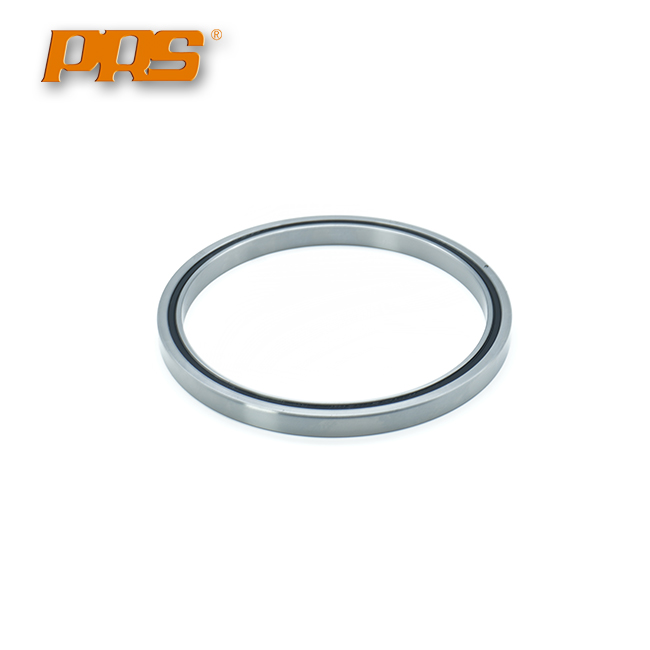
CRBS robot arm bearing
Brand: PRS
Category: Bearing
Seal: Double-sided seal
Size: Inner diameter 50mm-200mm, Outer diameter 66mm-226mm
Thickness: 8mm-13mm
- Product Description
CRBS Robot Arm Bearing – Ultra-Thin Crossed Roller Bearing for Compact Robotic Joints
For space-constrained robotic applications, Luoyang PRS Precision Bearing Co., Ltd. provides high-performance CRBS robot arm bearings. Since 2003, PRS has manufactured precision CRBS-type crossed roller bearings with integrated inner and outer rings without mounting holes. Ultra-thin bearings have inner diameters from 50mm to 200mm, exterior diameters from 66mm to 226mm, and thicknesses from 8mm to 13mm. Manufacturers achieve P4 and P2 precision for steady rotation and torque. Product units are suited for tiny robotic joints that need inner and outer ring rotation because the integrated ring design prevents installation-induced performance fluctuations.
Product Structure and Working Principle
The CRBS series uses crossed cylindrical rollers perpendicular to each other between integrated raceways. This bearing can withstand radial, axial, and moment loads in a small space.
Inner and outer rings are continuous in the integral ring construction. Installation uses flange and support seat fixation, not through-holes. This method retains raceway geometry and tightens assembly tolerances.
The crossed roller configuration reduces axial space and increases stiffness. Rollers touch the raceway at appropriate angles, transferring loads uniformly throughout the bearing. This arrangement lowers combined loading deflection, which is essential for multi-axis robotic joint accuracy.

Technical Specifications
| Parameter | Value |
|---|---|
| Bearing Type | CRBS Crossed Roller Bearing |
| Inner Diameter Range | 50mm – 200mm |
| Outer Diameter Range | 66mm – 226mm |
| Thickness Range | 8mm – 13mm |
| Precision Grade | P4, P2 |
| Seal Configuration | Double-sided seal |
| Ring Structure | Integral (no mounting holes) |
| Load Capacity | Radial, axial, and moment loads |
| Installation Method | Flange and support seat fixation |
Performance Advantages in Robotic Applications
Space Optimization
The ultra-thin profile allows integration into compact robotic wrist and elbow joints. Your design gains flexibility when envelope dimensions are constrained. Reduced bearing height translates directly to lighter arm segments and improved payload-to-weight ratios.
Installation Stability
Integral ring construction eliminates bolt-hole stress concentrations. You achieve consistent preload and alignment without concern for fastener-induced distortion. This stability ensures repeatable positioning accuracy across millions of motion cycles.
Rotation Precision
P4 and P2 grade manufacturing tolerances minimize radial and axial runout. Your robotic arm maintains positional accuracy below 0.01mm, which is essential for assembly tasks, precision welding, and inspection operations. Low friction coefficients reduce heat generation during continuous operation.
Load Distribution
Crossed roller geometry handles moment loads effectively. When your robot arm extends horizontally, the bearing resists tipping forces without requiring additional support structures. This capability simplifies joint design and reduces component count.
Application Scenarios
Collaborative Robots
Compact CRBS bearings fit within the narrow wrist joints of cobots operating in shared workspaces. The double-sided seal protects against dust and light contamination in electronics assembly environments.
Industrial Welding Arms
High rigidity maintains torch positioning accuracy during multi-pass welds. The bearing's ability to handle combined loads prevents deflection when the arm changes orientation under tool weight.
Material Handling Systems
Reliable rotation under continuous duty cycles reduces maintenance intervals. Your automated warehouse systems benefit from extended uptime and predictable replacement schedules.
Precision Testing Equipment
P2 grade accuracy supports measurement applications where positioning errors must stay within micron-level tolerances. The CRBS robot arm bearing maintains calibration stability across temperature variations.

Material and Manufacturing Quality
PRS manufactures product units from chrome steel, balancing hardness, durability, and cost-effectiveness. Heat treatment processes achieve optimal hardness gradients in raceways, extending fatigue life under cyclic loading.
Grinding operations are performed on precision CNC equipment with in-process dimensional verification. Each bearing undergoes raceway geometry inspection, runout measurement, and torque testing before assembly. Double-sided seals retain lubrication and exclude contaminants, extending service intervals in typical industrial environments.
The company's ISO 9001-certified quality system ensures traceability from raw material procurement through final inspection. This controlled manufacturing approach delivers consistent performance across production batches.

FAQ
Q: What installation methods are compatible with CRBS bearings?
A: CRBS types require flange and support seat fixation. The integral ring design lacks mounting holes, so you must use external clamping mechanisms that apply uniform radial pressure.
Q: How do I select between P4 and P2 precision grades?
A: P4 grade suits standard industrial robotics with positioning requirements around ±0.02mm. P2 grade is necessary for precision assembly, micro-positioning, or applications where runout must stay below 0.005mm.
Q: What lubrication intervals does PRS recommend?
A: Double-sided seals retain factory-applied grease for typical service lives of 10,000 operating hours under moderate loads. Relubrication schedules depend on load magnitude, speed, and ambient temperature. Contact our engineering team for application-specific guidance.
Q: Can CRBS bearings handle continuous rotation in both rings?
A: Yes. The integral structure and crossed roller arrangement support simultaneous inner and outer ring rotation, making them suitable for turntable applications and multi-axis robotic joints.
Q: What are the typical lead times for standard sizes?
A: Standard CRBS configurations within the 50-200mm diameter range typically ship within 2-3 weeks. Custom dimensions or non-standard precision grades require coordination with our production planning team.
Contact Us
For technical specifications, application engineering support, or quotation requests, reach our team at ljh@lyprs.com. We provide CRBS robot arm bearing selection guidance tailored to your robotic system requirements.

USER EVALUATE
Here is the customer's evaluation of us