


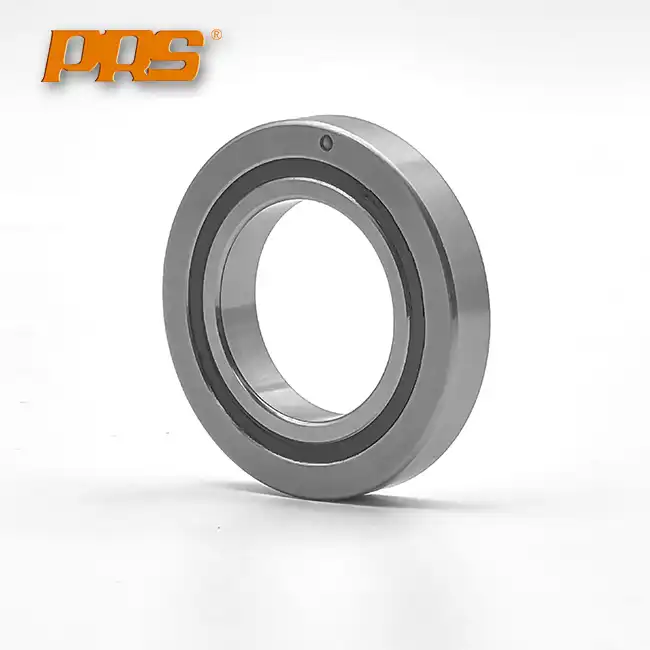
CRBH robot arm bearing
Brand: PRS
Category: Bearing
Seal: Double-sided seal
Size: Inner diameter 20mm-250mm, Outer diameter 36mm-310mm
Thickness: 8mm-25mm
- Product Description
CRBH Robot Arm Bearing – Ultra-Thin Crossed Roller Precision Solution
The CRBH robot arm bearing line from Luoyang PRS Precision Bearing Co., Ltd. has integrated ring constructions suited for space limits. These crossed roller bearings have diameter-to-thickness ratios up to 10:1 due to 30%-40% wall thickness reductions. Lightweight aluminum alloy cage minimizes rotational inertia by 15%-20%, and super-finished raceways keep friction below 0.0015. Sub-50dB operating noise.
For high-repeatability placement in small robotic joints and automated handling systems, CRBH bearings provide P4 and P2 precision grades in 20mm to 250mm inner diameter sizes.

Technical Specifications
| Parameter | Specification |
|---|---|
| Inner Diameter | 20mm – 250mm |
| Outer Diameter | 36mm – 310mm |
| Thickness | 8mm – 25mm |
| Precision Grade | P4, P2 |
| Friction Coefficient | ≤0.0015 |
| Operating Noise | ≤50dB |
| Seal Type | Double-sided thin rubber lip seal |
| Cage Material | Lightweight aluminum alloy |
| Diameter-to-Thickness Ratio | Up to 10:1 |
Design Features and Engineering Benefits
The product has integrated outer and inner rings without mounting holes. Installation-induced stress deformation in split-ring designs is eliminated by this structural method.
Assembly fixation needs flanges and support seats. Rotational precision and torque performance are stable throughout service life since both rings are monolithic. This design is necessary when inner and outer rings must spin while achieving size downsizing standards.
The crossed roller system rotates rollers 90 degrees. The bearing can manage radial, axial, and moment loads in one compact unit. You get multi-directional load capacity without stacking bearings.
Raceway super-finishing decreases roughness to sub-micron levels. Less surface imperfections mean less friction, better motion, and longer robotic joint component life.
Application Scenarios
The space-saving properties of CRBH crossed roller bearings help small robotic arms. Collaborative robots in tight environments need small joints without losing positional precision.
Semiconductor wafer handling equipment must be very clean. The low-friction design and excellent double-sided sealing avoid contamination and preserve wafer alignment throughout transfer cycles.
The lightweight design of portable measurement devices improves mobility. Reduced bearing mass reduces instrument weight by 15%-20%, making handheld or portable field measurements easier.
Pick-and-place systems, component insertion machines, and inspection stations in consumer electronics production employ these bearings for high throughput with minimum installation area.

Quality Control Standards
CRBH robot arm bearings are rigorously measured utilizing coordinate measurement devices. Radial and axial runout meets precision grades using inductive probe rotational accuracy testing.
Preload checks negative clearance values. Poor preload produces positional instability and vibration. Heat and premature wear result from excessive preload. PRS calibrates preload to precise tolerances for stiffness and thermal stability.
Rockwell testing validates heat treatment depth for raceway hardness. Proper hardening avoids shock brinelling and enhances cyclic bearing fatigue life.
Starting torque detects friction issues before shipping. Servo-controlled motion systems need adequate internal geometry, lubrication, and smooth raceway surfaces to have low beginning torque.
Maintenance Recommendations
Check bearing temperature at startup. Thermal expansion impacts clearance and preload. Recheck mounting alignment and preload if temperature exceeds design requirements.
Duty cycle and environment determine lubrication intervals. Over-lubrication increases churning losses and operating temperature, whereas under-lubrication promotes wear.
Check for odd vibration or noise during regular maintenance. Vibration amplitude or noise frequency changes indicate raceway damage, misalignment, or pollution needing prompt care.
Consider replacing before rated service life under your load and speed circumstances. Predictive replacement avoids downtime and component degradation.
Material Considerations
Chrome steel balances hardness and durability for most industrial robotic applications. This material performs cost-effectively in intermediate precision and normal operating settings.
Stainless steel variations withstand chemical exposure and preserve dimensional stability in food processing and cleanroom settings. The modest weight increase and cost premium safeguard unique situations.
Ceramic hybrids use steel raceways and ceramic rolling components. High-speed or micro-positioning jobs requiring maximum repeatability benefit from this configuration's bulk, heat resistance, and friction reduction.

FAQ
Q: What mounting method does the CRBH series require?
A: CRBH bearings have no mounting holes in the rings. You must use flanges and support seats to secure the bearing during installation. This integral ring design maintains consistent accuracy without bolt-induced deformation.
Q: Can these bearings handle simultaneous multi-directional loads?
A: Yes. The crossed roller arrangement handles combined radial, axial, and moment loads within a single bearing unit, eliminating the need for multiple bearing configurations.
Q: What precision grades are available?
A: PRS manufactures product series in P4 and P2 precision grades. Your application requirements for positioning repeatability and load capacity determine the appropriate grade selection.
Q: How does the ultra-thin design affect load capacity?
A: Despite reduced wall thickness, the crossed roller configuration and high-grade materials maintain adequate load ratings for compact robotic joints. Consult technical specifications for your specific size and load conditions.
Q: What lubrication type is recommended?
A: Grease lubrication suits most applications. Lubrication intervals depend on operating speed, temperature, and load conditions. Contact our engineering team for application-specific recommendations.
Contact Us
Need technical specifications or custom configurations for your robotic application with a CRBH robot arm bearing? Our engineering team provides application-specific guidance to optimize bearing selection.
Email: ljh@lyprs.com.

USER EVALUATE
Here is the customer's evaluation of us